EAH Industrial Spray Equipment & Coatings
EAH Industrial · SharkGrip Coatings · San Antonio TX

Professional Bathtub
Refinishing Process

Structured refinishing knowledge base for substrates, prep, bonding, coatings, troubleshooting, and process workflows. Built for the field.
TECH SUPPORT 210.822.9393
THE GOAL NEVER CHANGES

Clean • Dry • Dull

CHEMICAL PROFILE IF IT ETCHES → POWER BOND
MECHANICAL PROFILE IF IT SANDS → BULL SHARK
QUICK REF

Surface Decision Matrix

Start here. Tap any branch below for detail.
Surface
Prep Method
Bonding Choice
System Direction
Porcelain Tub
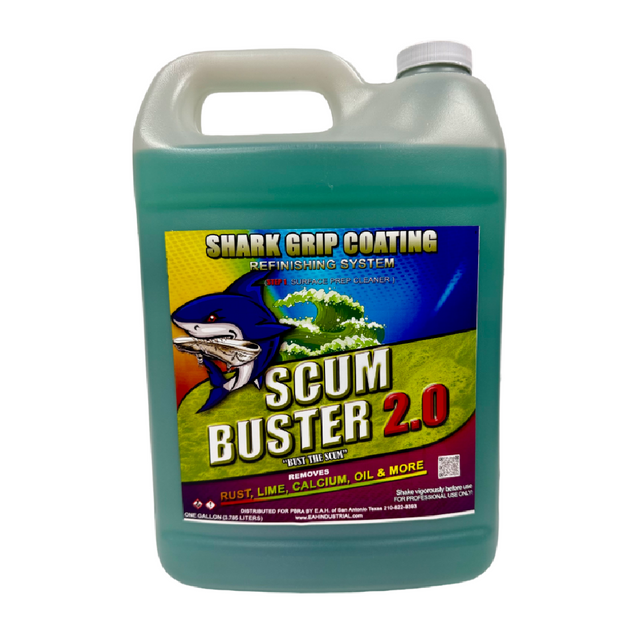
ScumBuster → Safe-Etch Gel → SWAT
Primer/topcoat system or compatible direct-to-surface system
Ceramic Tile
ScumBuster → Safe-Etch Gel → SWAT
Choose system by exposure, traffic, and customer expectations
Fiberglass / Cultured Marble / Composite
ScumBuster → Sand/Abrade → SWAT
Choose system by flexibility, use, exposure, and service conditions
Commercial Production
Surface-specific prep
Power Bond or Bull Shark based on prep method
High Gloss Epoxy or SharkThane Quick Dry based on production needs

Process Library

Start with the surface — not the coating. The substrate determines the prep path, the prep path determines the bonding agent.

Hard, glass-like fired surface over cast iron or steel. Chemically profiled — porcelain follows the etch path.

Recommended Prep
  1. ScumBuster pre-clean — remove soap scum, oils, and contamination
  2. Safe-Etch Gel — chemically profile the glaze, dwell per TDS
  3. Rinse and dry completely
  4. SWAT final wipe before bonding
Approved Bonding Method
Power Bond Wipe-On Primer VIEW →
Common Failures
  • Peeling at heel-strike zones from incomplete etch
  • Fisheyes from residue or silicone left behind
  • Edge lift at caulk lines coated over old silicone
Important Warnings
  • Verify a uniform dull profile across the entire surface before bonding — re-etch any shiny spots
  • Never skip the SWAT final wipe

Porcelain enamel over thin pressed steel. Lighter and more flex-prone than cast iron — same etch path, extra attention at stress points.

Recommended Prep
  1. ScumBuster pre-clean
  2. Safe-Etch Gel — chemical profile
  3. SWAT final wipe
Approved Bonding Method
Power Bond Wipe-On Primer VIEW →
Common Failures
  • Chips at rim and drain from impact — steel dents, enamel pops
  • Rust bleed at chips left untreated
  • Hairline cracking at flex points
Important Warnings
  • Treat all rust to bright metal before coating — see Rust Repair
Related Topics

Heavy cast iron with porcelain surface. Common in pre-1970s homes and clawfoot restorations. Etch path — but rust remediation usually comes first.

Recommended Prep
  1. Rust remediation at drain, overflow, and chips — to bright metal
  2. ScumBuster pre-clean
  3. Safe-Etch Gel — chemical profile
  4. SWAT final wipe
Approved Bonding Method
Power Bond Wipe-On Primer VIEW →
Common Failures
  • Rust bleed-back at the drain and old chips if not fully treated
  • Ghosting of deep stains through thin film builds
Important Warnings
  • Rust left behind WILL telegraph through the topcoat — there are no shortcuts here
Related Topics

Glazed ceramic tile follows the etch path like porcelain. Grout lines are where most tile jobs fail — profile them like they matter, because they do.

Recommended Prep
  1. ScumBuster pre-clean — work the grout lines
  2. Replace failing caulk; remove all silicone residue
  3. Safe-Etch Gel across glaze AND grout
  4. SWAT final wipe
Approved Bonding Method
Power Bond Wipe-On Primer VIEW →
Common Failures
  • Pinholing over porous grout
  • Peeling on glaze where the etch was incomplete
  • Cracking over loose or hollow tiles
Important Warnings
  • Re-secure loose tiles before coating — coating doesn't fix structure

Flexible composite with a gel coat surface. Mechanically profiled — fiberglass follows the sand path. Fix the flex before you coat.

Recommended Prep
  1. ScumBuster pre-clean
  2. Sand/abrade — break ALL gloss, hit the low spots (dustless sanding recommended)
  3. SWAT final wipe
Common Failures
  • Cracking from substrate flex — soft floors, unsupported pans
  • Delamination where sanding missed low spots
Important Warnings
  • Repair structural flex BEFORE coating — a coating over a moving floor is a callback with your name on it

Thermoformed plastic — common in newer construction and inserts. Sand path, with extra care: these substrates can be solvent-sensitive.

Recommended Prep
  1. ScumBuster pre-clean
  2. Scuff sand to a uniform dull — no remaining gloss
  3. SWAT final wipe — light passes, fresh cloth faces
Common Failures
  • Crazing from aggressive solvent flooding
  • Poor adhesion on un-sanded gloss areas
Important Warnings
  • Test solvent response in an inconspicuous area — hot solvents can craze acrylic
Related Topics

Cast polymer with a gel coat surface — vanity tops, surrounds, and integral-bowl sinks. Also called CM or synthetic marble. Sand path, no exceptions.

Recommended Prep
  1. ScumBuster pre-clean
  2. Sand through the gloss completely — uniform dull across the whole surface
  3. SWAT final wipe
Common Failures
  • Bond failure on remaining gloss patches
  • Dark veining or translucent patches telegraphing through thin builds
Important Warnings
  • The gloss must be FULLY broken — CM punishes lazy sanding harder than any other substrate

Plastic laminate countertops and surfaces. Sand path. Glue-down condition matters more than the laminate itself.

Recommended Prep
  1. Re-glue any loose or lifting laminate, especially edges and seams
  2. ScumBuster pre-clean
  3. Scuff sand to uniform dull
  4. SWAT final wipe
Common Failures
  • Edge lift at seams that weren't re-glued
  • Bubbling over delaminated substrate
Related Topics
Every professional job ends Clean, Dry and Dull. The method changes by surface — the goal never does.

Clean first — always. Oils, soap scum, and body residue kill adhesion and cause fisheyes. Profiling a dirty surface grinds contamination IN.

Process
  1. Apply ScumBuster across the full surface
  2. Agitate — corners, around the drain, under the rim
  3. Rinse thoroughly and inspect; repeat on heavy buildup
Important Warnings
  • Clean BEFORE you sand or etch — never after
Related Topics

Silicone is the number-one fisheye generator in this trade. Even invisible residue repels coating. Remove it mechanically, then chase the residue.

Process
  1. Cut and strip all caulk lines mechanically
  2. Scrape remaining film — razor at low angle
  3. Solvent-clean the joint and surrounding area until it squeaks
Important Warnings
  • NEVER coat over silicone — trace residue you can't see is enough to crater a finish
Related Topics

Chemical profiling for porcelain and ceramic tile. The gel formulation clings to vertical surfaces so the dwell does the work. This path leads to Power Bond.

Process
  1. Apply Safe-Etch Gel evenly across the cleaned surface
  2. Dwell per TDS — agitate during dwell
  3. Rinse completely, dry, and verify a uniform dull profile
  4. Re-etch any spots that still shine
Important Warnings
  • Full PPE — gloves, eye protection, ventilation
  • Shiny spots = future peel spots. Verify the dull before moving on

Mechanical profiling for fiberglass, cultured marble, acrylic/ABS, Formica, and composites. This path leads to Bull Shark. Dustless sanding keeps the bathroom — and your lungs — clean.

Process
  1. Sand the full surface — break ALL gloss, including corners and radii
  2. Hand-sand where the machine can't reach
  3. Vacuum and tack before the final wipe
Important Warnings
  • Remaining gloss = guaranteed bond failure. If it still shines, you're not done
  • Feather all repairs flush before final profiling

The last step before bonding — after profiling, before Power Bond or Bull Shark. SWAT removes all traces of contamination from the profiled surface.

Process
  1. Use clean, lint-free cloths — turn to a fresh face frequently
  2. Wipe systematically; don't redeposit what you just picked up
  3. Bond immediately after — don't let the surface sit and recontaminate
Related Topics
Repairs come BEFORE profiling and coating. A finish over a bad repair is a callback on a schedule.

The bread-and-butter repair. Fill proud, sand flush, feather wide.

Process
  1. Grind out the chip and clean to sound material
  2. Fill with a refinish-rated filler — slightly proud
  3. Sand flush and feather the edges wide
  4. Spot-treat per the surface's prep path before coating
Important Warnings
  • A hard edge on a repair telegraphs through every coat above it
Related Topics

A crack is a symptom. The disease is movement. Cosmetic fill over a moving crack WILL return — usually within the warranty window.

Process
  1. Identify why it cracked — flex, impact, or stress point
  2. Stop-drill or grind out the crack fully
  3. Reinforce from behind if the substrate flexes
  4. Fill, fair, and feather before profiling
Important Warnings
  • If the floor still moves, the crack comes back. Fix the movement first
Related Topics

Cast iron and steel tubs rust at the drain, overflow, and old chips. Rust left behind bleeds through the topcoat — every time.

Process
  1. Remove ALL oxidation to bright metal — grind, don't wish
  2. Treat/convert remaining traces per product instructions
  3. Fill and fair the area flush
  4. Prime promptly — bare metal flash-rusts fast in a wet room
Important Warnings
  • "Mostly removed" rust is rust. It will telegraph orange through your finish
Related Topics

Flexing fiberglass pans need reinforcement before anything else happens. Coat AFTER the structure is solid — never before.

Process
  1. Map the soft area under load
  2. Reinforce — foam injection or inlay system per the situation
  3. Verify the floor is solid under full body weight
  4. Then proceed to standard sand-path prep
Related Topics

The drain area takes the most water, the most standing exposure, and the most abuse. Finish quality here defines the service life of the whole job.

Field Notes
  • Best results when the coating runs under the drain flange where feasible
  • Treat rust at the drain before anything else — see Rust Repair
  • Plumbing license rules on drain work vary by state — check the laws in your state and confirm coverage with your insurance agent
Related Topics
Your profiling method determines the bonding product. If it etches → Power Bond. If it sands → Bull Shark.

The bonding agent for etched porcelain and ceramic tile. Wipe-on application — a thin, uniform film is the goal.

Application
  • Apply after the SWAT final wipe, to a fully dry surface
  • Thin and uniform — wipe on, don't flood
  • Observe flash time per TDS before the next step
Important Warnings
  • Less is more — puddles and heavy film cause problems downstream

The bonding agent for sanded fiberglass, cultured marble, ABS, Formica, and composites.

Application
  • Apply after a complete gloss break and SWAT final wipe
  • Uniform application across the full surface
  • Observe flash time per TDS before priming or topcoating
Important Warnings
  • Bull Shark can't fix lazy sanding — full gloss break first, always

The build layer of the primer/topcoat system. Improves hiding, film build, impact distribution, and overall system strength beneath the finish coat.

Where It Fits
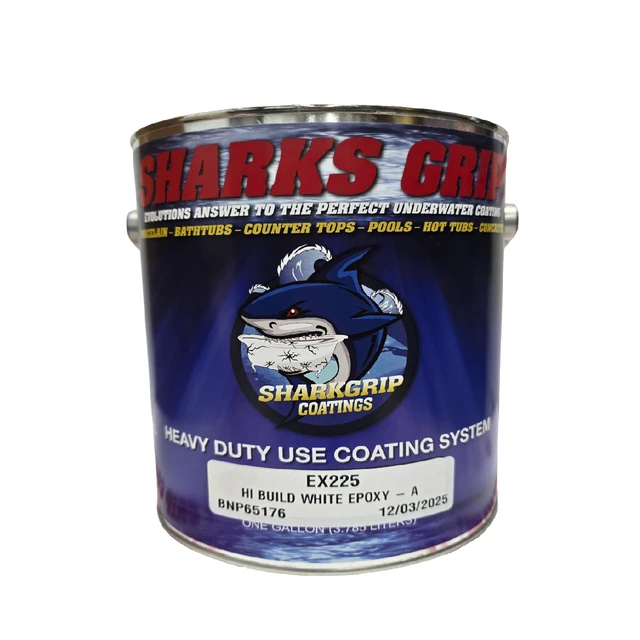
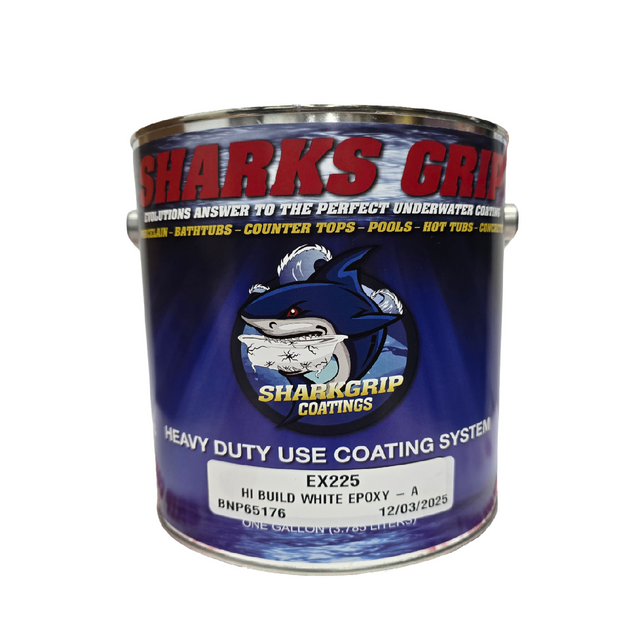
  • Power Bond or Bull Shark → High Solids Epoxy Primer → Selected SharkGrip finish system
  • Use when the job needs build, hiding, or impact distribution beneath the finish
Important Warnings
  • Do NOT use beneath Liquid Porcelain Enamel unless specifically instructed by SharkGrip Technical Support — see The LPE Rule

Flash time is when solvent leaves the film. Rush it and you trap solvent — that's blistering 30 days later. Miss the recoat window and you risk intercoat delamination.

Field Notes
  • Follow the TDS for the specific product — flash windows are not interchangeable between systems
  • Temperature and humidity move the windows — cold and damp = longer flash
  • When in doubt, call Tech Support before spraying the next coat

One rule, no exceptions without a phone call.

The Rule
  • Do NOT use SharkGrip High Solids High Build Epoxy Primer beneath Liquid Porcelain Enamel unless specifically instructed by SharkGrip Technical Support
  • Need more build under LPE? Spray additional coats of LPE itself
SharkGrip's finish systems are not competing against each other — they're different tools for different jobs. Match the coating to the performance need.

The difference is not good versus bad. The difference is the right tool for the job. Start with the performance need:

Commercial Production · Hotels · Immersion
→ High Gloss Epoxy
Fast Turnaround · Same-Day · Rentals
→ SharkThane Quick Dry
Ease of Application · Smoothest Spray
→ Liquid Porcelain Enamel
Max Resistance · UV · Exterior
→ SharkThane Plus

The commercial production workhorse. Direct-to-surface capable, immersion service rated — apartments, hotels, and high-volume schedules.

Best For
  • Commercial production and multi-unit work
  • Immersion service conditions
  • Direct-to-surface with additional build coats, or over High Solids Epoxy Primer

The easiest professional system to spray. Direct-to-surface capable and immersion service rated. Build comes from additional coats of LPE itself.

Best For
  • Refinishers who want the smoothest application experience
  • Direct-to-surface workflows
Important Warnings
  • The LPE Rule applies: no epoxy primer beneath LPE unless Tech Support instructs otherwise
Related Topics

Maximum chemical resistance, stain resistance, UV absorbers, anti-graffiti performance. Exterior work, pool slides, water parks, harsh environments.

Best For
  • Exterior and UV-exposed applications
  • Pool slides, water parks, harsh-service environments
  • Maximum chemical and stain resistance demands
Related Topics

There are two ways to get build: a primer/topcoat system using High Solids Epoxy Primer beneath the finish, or direct-to-surface with additional coats of the finish system itself.

Why Build Matters
  • Improves hiding over repairs and stains
  • Distributes impact energy more evenly across the surface
  • Creates a more durable coating stack for the service conditions
Important Warnings
  • The goal is enough build for the job's service conditions — not extra material for its own sake

The finish is made at the gun. Pattern, distance, overlap, and a wet edge — the fundamentals don't change between systems.

Fundamentals
  • Test the pattern on masking before touching the surface
  • Consistent distance, 50% overlap, maintain the wet edge
  • Match needle/cap setup and viscosity to the system's TDS
  • Turbine HVLP only — no compressors in this system. 5-stage minimum, 6-stage recommended: more stages move more air, and there's no replacement for displacement
  • Turbine HVLP keeps overspray manageable in tight bathrooms — keep the filters clean so airflow stays honest

Temperature and humidity move every window — flash, recoat, and cure. Cold chemistry behaves differently. Plan the environment like it's part of the system, because it is.

Field Notes
  • Cold product = thicker viscosity, slower flash, longer cure — condition your chemistry
  • High humidity slows solvent release; adjust your schedule, not your standards
  • Balance ventilation airflow against overspray control
Most field failures trace back to prep, contamination, or film build. Find the symptom — work back to the cause.

Round craters where the coating pulls away from a contaminated spot. Cause: silicone or oil — on the surface, in the air line, or on your gloves.

Likely Causes
  • Silicone residue from old caulk or "tub shine" products
  • Body oils, soap scum, or cleaner residue under the film
  • Contaminated cloths, gloves, or strainers after the final wipe
Prevention
  • ScumBuster pre-clean + full silicone removal + SWAT final wipe
  • Clean turbine filters, fresh lint-free cloths, clean gloves after the final wipe

Diagnose by which layer released. Coating off the substrate = prep/bond failure. Coat off coat = intercoat failure.

Likely Causes
  • Wrong path — sanded surface bonded like an etched one, or vice versa
  • Incomplete profile: shiny spots, missed gloss
  • Skipped or contaminated final wipe
Prevention
  • Honor the rule: if it etches → Power Bond; if it sands → Bull Shark
  • Verify Clean, Dry and Dull before every bond — no exceptions
Related Topics

Solvent or air trying to escape through a skinned-over film. Shows up immediately — or 30 to 90 days later as blisters.

Likely Causes
  • Coats applied too heavy
  • Rushed flash between coats — solvent entrapment
  • Outgassing from porous repairs or grout
Prevention
  • Medium coats, full flash per TDS, adjusted for temp and humidity
  • Seal porous areas before building film

Texture in the finish — the droplets landed and never flowed out.

Likely Causes
  • Underpowered turbine for the viscosity — below 5 stages, atomization starves
  • Gun too far from the surface, or air/fluid balance off at the gun
  • Hot, dry conditions flashing the droplets mid-air
Prevention
  • Mix and reduce per TDS; verify pattern on masking first
  • Consistent distance and overlap; adjust for environment

The coats didn't become one film. Intercoat adhesion failed.

Likely Causes
  • Exceeded the recoat window without re-profiling
  • Contamination landed between coats
  • Incompatible products stacked outside the system
Prevention
  • Stay inside the recoat window per TDS — or scuff and re-wipe
  • Keep the system inside one chemistry family unless Tech Support approves
Related Topics

Whites drifting warm over time. Usually a UV story.

Likely Causes
  • UV exposure on a system without UV absorbers — windows, skylights, exterior
  • Sustained heat sources near the surface
Prevention
  • Spec SharkThane Plus where UV exposure is part of the service environment
Refinishing chemistry is professional-grade. Treat it that way, every job.
Field Standards
  • Organic vapor protection is the floor — follow the product's TDS/SDS for the system you're spraying
  • Fresh-air supplied systems where the TDS calls for them
  • Fit-test, maintain, and replace cartridges on schedule — not on vibes
Field Standards
  • Exhaust to the exterior — protect occupants and adjacent spaces
  • Negative air in the work zone; manage makeup air paths
  • Balance airflow against overspray control at the gun
Related Topics
Field Standards
  • Chemical-resistant gloves for prep chemistry and solvents
  • Eye protection during etching, sanding, and spraying
  • Suits for spray work — your skin is not a filter
Related Topics
Field Standards
  • Keep SDS sheets accessible for every product on the truck
  • Store chemistry inside its temperature range — cold chemistry behaves badly
  • Dispose of solvents and waste per local regulations
Related Topics

Need Help Choosing the Right System?

Call SharkGrip and we'll help match the right preparation, bonding agent, film build, and finish system to your surface, customer, schedule, and performance requirements.

CONCEPT MOCKUP · PREPARED FOR EAH INDUSTRIAL REVIEW · OSCAR — MANGROVE DIGITAL MEDIA
PRODUCTION URLS FOLLOW /BRANCH/NODE STRUCTURE · e.g. /surface-types/cultured-marble · /troubleshooting/fisheyes